Updated 3 September
Argyll and Bute Council has had a Topographic Survey of the area at Clachan Bridge, carried out by Traffic Light Consultants to ensure there is a detailed measurement and map of the area.
In response to the concerns raised by local residents, businesses and the relevant community councils, we have agreed to carry out a Traffic Survey at both approaches to the Clachan Bridge which will confirm traffic numbers, average speeds and, if possible, details of vehicle types. This will be carried out by an external company within the next few weeks.
We will then look to have an external Road Safety Audit carried out by an independent company based on the topographic survey and the traffic survey. We can also advise the external consultant of the various points raised by local residents, businesses as well as the community councils and ward elected members.
Once we have received the results of the Road Safety Audit, we would intend to meet again with the community councils and go over the recommendations. Some of the recommendations which may come out of the Road Safety Audit may include alternative types of traffic control other than traffic lights. This will be discussed at the future community council meeting and thereafter we will look at engagement with the local community.
We have contacted Historic and Environment Scotland (HES) and made them aware of what we are proposing and advised we are happy to discuss further with them.
Updated 24 June 2026
Purpose
This provides an update to elected members and community representatives on proposed activity prior to any decision being taken on safety measures at Clachan Bridge. It also reflects the motion proposed by Councillor Green at the Oban, Lorn and the Isles Area Committee on 10 June 2026.
Background
A previous report was issued on 15 May 2026. Since then, further engagement has taken place with community representatives and a local resident to gain a better understanding of concerns around proposed road safety measures at Clachan Bridge, including the proposed introduction of traffic signals.
Area Committee Decision
After a vote, Committee agreed that:
“The Oban Lorn and Isles Area Committee welcomes the Clachan Bridge update provided to members earlier in the meeting, which confirms that an options appraisal, traffic survey, and further community engagement will be conducted prior to a report being presented to the Area Committee in due course, and that any decision to progress with works at the location will only happen after this.”
Engagement Undertaken
Site meetings have taken place between the RIS Network and Standards Manager, community council representatives and a local resident. These were positive meetings and raised a range of issues, including cyclist and pedestrian safety, how traffic signals would operate, and how vehicles using the Tigh an Truish car park would be detected and managed.
Technical Assessment and Design Work
The points raised through local engagement have informed discussions with SWARCO, the Council’s appointed traffic light consultant. SWARCO will carry out the design work for any traffic light system at Clachan Bridge. Initial discussions have identified the potential for a separate cyclist traffic light arrangement, operating in tandem with the vehicle signals, to detect approaching cyclists and provide a green signal for cyclists while delaying vehicle movements.
In the meantime, further technical assessment work will be carried out to address community concerns. This will involve
-
Traffic surveys and associated data analysis, including vehicle speeds, types, volumes and, where possible, queueing traffic. This work will be carried out in terms of the council’s agreed policy, which specifies the months that these surveys should be carried out
- An external Road safety audit to assess the implications of any proposed measures.
- Further member and community engagement to ensure local views continue to inform the options appraisal.
Officers remain at the assessment stage. No decision to progress works will be taken until an options appraisal has been completed, taking account of the traffic survey, road safety audit and further engagement.
It should also be noted that any proposal to install traffic lights will be for an initial three-year trial period, and that the trial can be concluded during this period if it is established that they are no longer required.
Interim Safety Measures
In the meantime, signage has been erected to improve driver awareness on the approaches to Barnacarry, in line with concerns raised by local community councils. Officers are also proposing the introduction of SLOW road markings as part of the safety improvements. Other proportionate, low-level safety measures, such as vegetation management and visibility enhancements, will also be considered where they can be delivered with the support of the local landowner and independently of any larger future infrastructure decisions. Officers intend to revisit the roadside to the Clachan Bridge and tidy up some of the earth mounds on the approach to the bridge where the road has been widened in the coming week.
Next Steps
Members of the Oban, Lorn and the Isles Area Committee and relevant community councils will receive update reports once the surveys and assessments have been reviewed. A further report will be brought back to a future meeting of the Area Committee for its consideration before any decision is taken by officers on whether to progress works at Clachan Bridge.
The council is taking steps to improve the safety of Clachan Bridge for those who use it by installing traffic lights, in the approach to the bridge. This action follows concerns from the public and the council, which is also supported by Police Scotland, regarding safety risks to bridge users; and more widely about the risk of a collision on the bridge cutting off access to and from the Isle of Seil.
Clachan Bridge
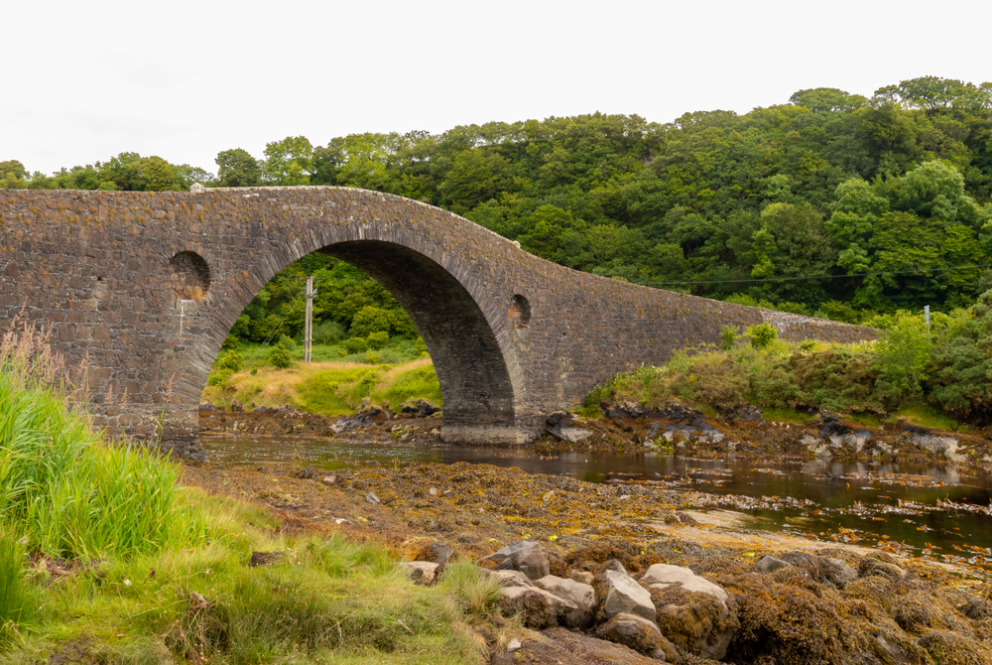
Clachan Bridge is a single-arched, hump-backed, masonry bridge spanning the Clachan Sound and also known as The Bridge over the Atlantic on the B844. It was built between 1792 and 1793 and links the west coast of the Scottish mainland to the island of Seil. The approach to either side of the bridge consists of a single carriageway with sufficient width for two vehicles to pass safely, however the bridge itself is reduced to one lane only with a speed limit of 30mph.
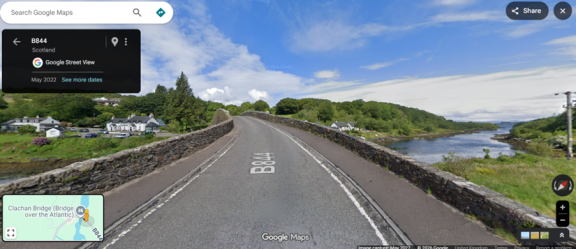
View travelling northwest approaching the Clachan Bridge:
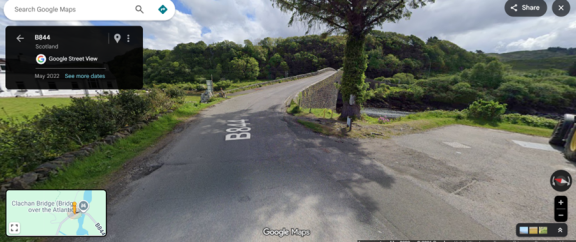
View travelling East approaching Clachan Bridge (below):
Why action is being taken
There is a lack of visibility on the approach to both sides of the bridge -as can be seen in the photos. Motorists and cyclists on one side cannot see if there are road users approaching from the other side of the bridge.
This is a clear road safety issue, as underlined by concerns raised locally with the council. It is also the view of Police Scotland – ‘There is no view afforded on either side of traffic on the bridge and due to the steep incline all forward view is lost until a vehicle has passed the summit and is beginning to decline’.
The council has already taken the step of testing warning signs as a way to reduce this risk to road users and increase safety. However this has not been enough to address concerns.
An accident at the bridge would risk not only injury to bridge users, and the bridge itself, but would also bring the risk of closing the road and access to the Isle of Seil.
How the bridge will be protected
The council is keen both to address road safety issues and look after the bridge.
No works therefore will be carried out on the bridge. Traffic lights will be installed on the approach to the bridge only.
It is worth remembering that a collision on the bridge could have an impact on the bridge itself as well as on the people involved, so increasing road safety reduces the risk of damage to the bridge.
Work being done
This is a historic bridge built originally for horses and carts, not vehicles of the size of many of today’s cars and lorries.
Lights are being installed on the carriageway leading to the bridge, and not on the bridge itself. The lights are vehicle activated so will change in response to vehicles needing to use the bridge rather than to fixed time cycles for changing.
The council secured funding from the Scottish Government’s Road Safety Infrastructure Fund and the project has been accepted by Transport Scotland. The cost of the works is estimated at £35,000 dependent on cost for connection from SSE (Scottish Southern Electric).
Process for carrying out the work
In brief, there is a clear risk to bridge users given the lack of visibility approaching the bridge. The bridge itself cannot be altered to address road safety concerns. Works being done affect only the road and do not alter the bridge. The project delivers a positive improvement to road safety and access to Seil Island and does not give rise to any changes that negatively affect island communities. The council can therefore proceed to install the lights.
We have been asked about the need for an Island Communities Impact Assessment. We have not undertaken one here for these reasons:
- Community impact assessments typically consider economic, demographic, and societal impacts. The traffic signal installation does not alter population profiles, create disadvantage, or introduce additional burdens for residents of Seil, Easdale, or Luing. On the contrary, it enhances safety for all road users accessing and leaving the island.
- The proposed works are operational and directly address public concerns regarding road safety. They do not constitute a change to Council policy, strategy, or service provision. The improvements aim to reduce the likelihood of collisions caused by poor visibility on the bridge approaches. As the historic structure cannot be physically altered to resolve these risks, the installation of traffic signals represents the most appropriate mitigation.
- On this basis, the proposal complies fully with the Council’s statutory duties under the Islands (Scotland) Act 2018. The project does not create any negative or differential impact that would require a full Integrated Impact Assessment.
An officer from the council has engaged with local councillors and will meet with community councillors if they wish. We acknowledge that engagement could have been undertaken earlier and more effectively, and we apologise for this.
Our focus is on delivering a project that responds to clear road safety risks, for the benefit of bridge users, the bridge itself and the Isle of Seil more widely.