Oban North Pier Pontoons were damaged during Storm Eowyn in January 2025. Following detailed investigation, some parts of the facility remained closed, for public safety, when it re-opened in March 2025. Further work is now underway to re-open as much of the facility as possible for the season starting April 2026.
Update - 18 September 2026
The temporary reconfiguration was completed between February and May 2026. This relocated damaged units and increased available berthing capacity by approximately 240 metres in time for the 2026 sailing season and the successful return of the Clipper Round the World Race. Around 60 metres of berthing remains unavailable due to the extent of damage to two pontoon units.
We will continue to update when we have further details of the next stage of the works.
Update - 7 May 2026
Since the last update, further progress has been made on the North Pier pontoons, with Breakwater Leg 2 now reopened to users. This marks a significant increase in available berthing area and represents an important milestone towards full reinstatement of the facility.
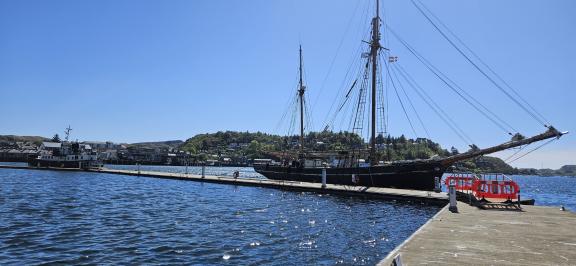
Reopened Leg 2, with Bessie Ellen alongside
A small amount of outstanding work remains on Breakwater Leg 3. This includes the installation of pad eyes to maintain connection of the damaged units and installation of electrical cabling to all the breakwaters.
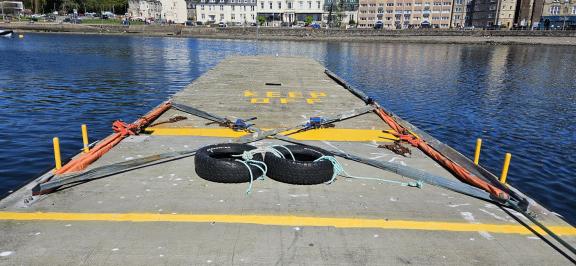
Damaged Unit on Leg 3 - please keep clear
In addition, part of the final section of Leg 3 will remain permanently closed until replacement pontoon units can be installed as part of the planned works programmed for the coming winter period.
Once the remaining works are completed and safety checks satisfied, the remainder of Leg 3 will be opened where possible.
Updates will continue to be provided via this webpage, the North Pier Pontoons Facebook page, and through Notices to Mariners, as appropriate.
Update - 15 April 2026
Since the last update advising that the finger berths had reopened, the harbour team has been re‑installing water connections to all breakwater pedestals in advance of the annual inspection and water sampling programme that is carried out each year. This work also included repairs to a number of pedestals that were damaged during last season. All of this activity was completed on 6 April, after which the water supply was reinstated and the system fully flushed.
While final sampling results are still awaited, the team agreed that sufficient progress had been made to allow Breakwater Leg 1 to reopen. This will enable use by visiting cruise tenders and larger vessels. The harbour staff will advise once the water is available for use.
There is, however, some further minor work required before Breakwater Legs 2 and 3 can be safely reopened. This includes:
- Reinstatement of cabling
- Installation of bridge guide posts on Bridge 2
- Installation of new decking to Bridge 3
- Replacement of cleats
Once these works are completed safely, Legs 2 and 3 will be brought back into service.
As this work continues, further Notices to Mariners will be issued as required. Updates will also continue to be posted on this webpage and on the North Pier Pontoons Facebook page.
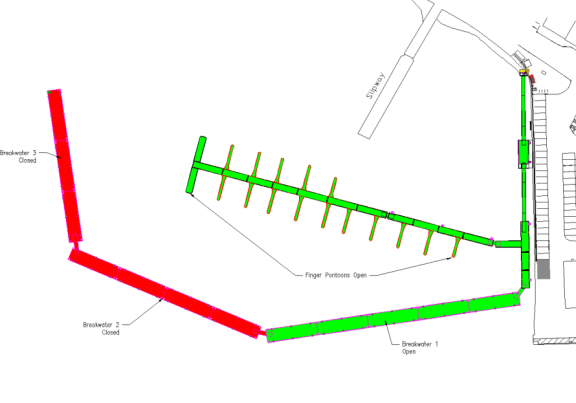
Diagramme shows parts of the facilities that are currently available for use in green.
Update - 1 April 2026
Over the last two weeks, significant progress has been made across the breakwater system as we continue working toward re-opening.
All units have now been relocated, including the most damaged units, which have been moved to the outermost sections of the breakwater. The damaged unit has been temporarily secured in position using strops and lever hoists. While this unit will still operate as a breakwater, it will not be available for berthing this season and remains scheduled for full replacement over the coming winter, as previously advised.
Unfortunately, on Sunday 29 March, one of the aluminium cleats being used to support the temporary strops failed during a period of high wind and swell. This was repaired on Monday 30 March, and the unit has now been brought back into alignment with additional fixings in place. To prevent similar issues, all aluminium cleats involved in maintaining this connection will be replaced with stronger stainless-steel rings.
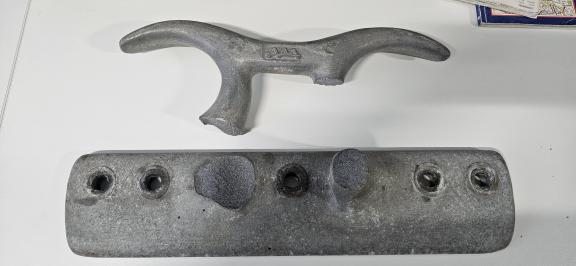
The broken cleat - We had hoped it might manage to hold a little longer but these will be replaced with stainless steel rings to help us manage summer storms.
The final bridge was also dropped back into place at the end of last week, which was very welcome news for the harbour team. However, this section still requires new decking, so it will remain closed until the replacement decking is received and installed.
With diving operations now complete, the Harbourmaster was able to reopen the finger berths from the evening of Wednesday 31 March. We also hope to reopen Breakwater 1 before the end of this week, albeit with some restrictions. This will be confirmed via a Notice to Mariners, so please keep an eye out for updates - Notices to Mariners | Argyll and Bute Council
Work is still ongoing on the topside of Breakwaters 2 and 3, as well as the bridge section mentioned above. These areas will be reopened in a phased manner. As noted previously, some minor restrictions on parts of the breakwater are likely to remain in place, and these will continue to be communicated through Notices to Mariners. If you are unsure of what is currently available, the Harbour team is always happy to provide guidance. You can call them on 01631 562 892.
We continue to thank everyone for their patience and support as we complete these final stages and move toward fully reopening the facility.
Update: 20 March 2026
This week has seen another strong spell of progress on the breakwater repairs, with the contractor working extremely hard to move the project forward and complete as early as possible.
Leg 2 of the breakwater has now been fully installed onto its moorings and the bridge linking Leg 1 and Leg 2 returned to position, marking a major milestone in the repair programme. In addition, the access bridge that was recovered from the seabed earlier has now been fully checked and approved for re-use following some minor welding repairs to the handrails. We are currently awaiting delivery of a new hinge bracket, after which the bridge can be put back in place between Leg 2 and Leg 3.
Work has also continued on Leg 3, where the team has partially reinstated the units and is now focusing on securing the most damaged section to the end of the breakwater.
Some further tasks will still be required on the breakwaters, including installing the third bridge, repairing fenders, and reinstating water and electrical services. Because of this, the facility will reopen on a phased basis.
As covered in last week’s update, we expect Leg 3 to open under a weight restriction as part of its temporary configuration. Details on this will be confirmed in due course as we move steadily to reopen the facility to all.
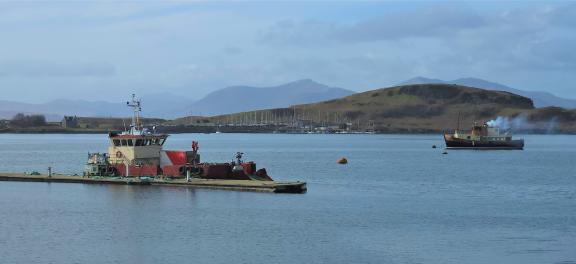
The Grace Lamont moving the damaged unit to the end of the facility
Update: 13 March 2026
Despite some very challenging weather this week, the team made excellent progress on the breakwater repairs. One of the most important stages of the project, re‑tensioning the breakwaters, has now been completed. This involved carefully installing new cabling inside the units and pulling them to a high level of tension before securing them in place. The team worked hard through some difficult weather conditions to complete this stage.
During the recovery of the access bridge, some cracks were discovered in the aluminium handrails. As a precaution, the bridge has been taken to the fabricator’s yard to be fully inspected, repaired and cleaned. It will return to site once it’s ready for reinstallation.
Today (Friday 13 March), the team have begun to move the breakwater units back into their original positions and reconnecting them to the mooring chains. This will let us monitor how the units behave in their new configuration and check whether any final adjustments to the cable tensioning are required before we seal everything off.
There are still works to complete, but this week marks a very positive step forward and we hope to be in a position to share a clearer timescale for reopening soon.
As part of the preparation for a safe reopening, the most damaged unit is being moved to the end of the facility. Although it won’t be available for berthing, it will still play an important role in providing protection and supporting safe navigation. To do this, it will be securely connected to the neighbouring unit using approved temporary fittings, allowing it to act as a buffer helping vessels to enter the facility safely.
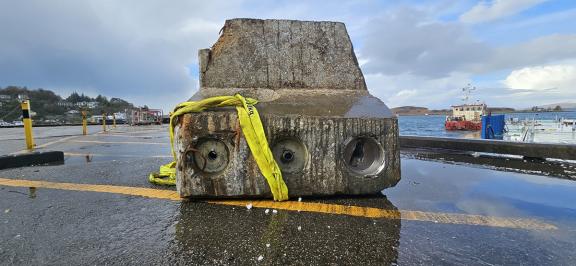
The most damaged part has been recovered to the pier ready for removal.
Because this leg of the breakwater will be operating in a temporary configuration until the replacement unit is installed, we expect to put a weight limit in place for vessels using Leg 3. This is a precautionary measure while we observe how the units behave in their new arrangement. Details of the weight limit will be confirmed before reopening.
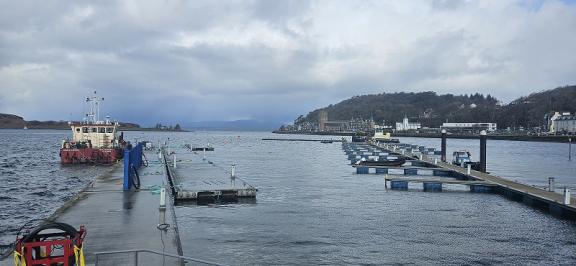
The CT Barnston and team starting to move Leg 3 back into position
Although this means Leg 3 won’t be fully operational straight away, the temporary solution ensures the breakwater will still offer protection, safe access, and continued functionality for the wider facility. This forms part of our plan to get the North Pier Pontoons reopened as soon as it is safe to do so, while still progressing towards the long‑term repairs.
Update: 5 March 2026
Over the past fortnight, Shearwater’s marine team have completed one of the most carefully planned stages of the project, assessing and then cutting the tension cables that hold the breakwater units together. Cutting the tension cables is a highly specialised and potentially hazardous operation. After detailed preparation and safety checks, the cables were successfully cut on Tuesday 3 March, which means each breakwater unit is now fully separated and can be worked on individually.
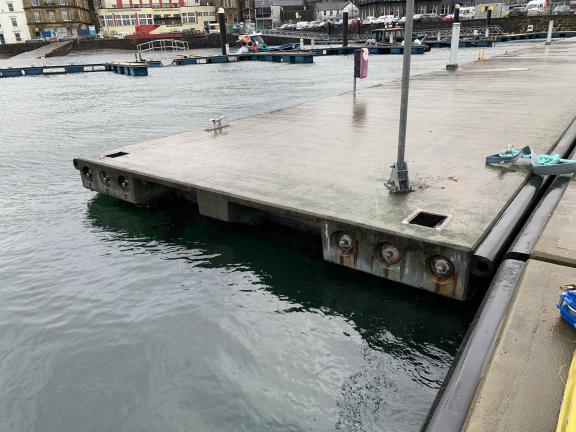
Exposed tension anchors - the ends of the tension anchors being prepared for removal
With the units now free, Shearwater can begin repositioning them and carrying out targeted repairs on those that suffered the greatest storm damage.
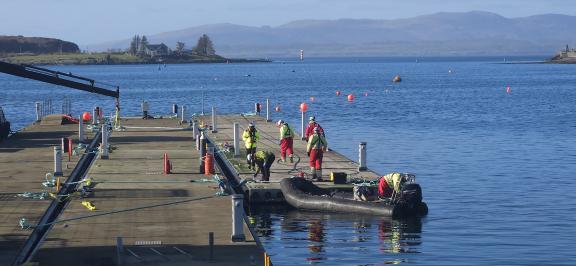
Recovering cables - The team at work recovering the cables onto the units for inspection and then disposal
Next week
The site team will move on to a series of minor but important repairs on the units, including:
- localised concrete repairs
- replacement of damaged mooring chain links
- Repairing damaged to fendering and some bent pedestals, these were not affected by the storm but we are using this opportunity to carry out these repairs whilst the facility is closed, and
- assessing the recovered bridge to certify the welds are still intact and the alignment remains true, hopefully allowing us to re-use this asset.
These works will allow the units to be re‑arranged and then re‑tensioned once repairs are complete.
19 February 2026
Shearwater have made steady progress on site this week.
The CT Barnston multi‑purpose vessel joined the team at the end of last week, bringing significant heavy lifting capability that is vital to supporting these operations. Its arrival has already made a huge difference to the recovery and repair work.
Bridge Recovered
On Monday, the team successfully recovered the bridge section that was swept away during the January 2025 storm. Despite spending a full year underwater, the bridge has emerged in surprisingly good condition.
Over the coming days it will be thoroughly cleaned and inspected, including checks to its welds and fixings, to confirm whether it can be safely reinstated as part of the final repair works.
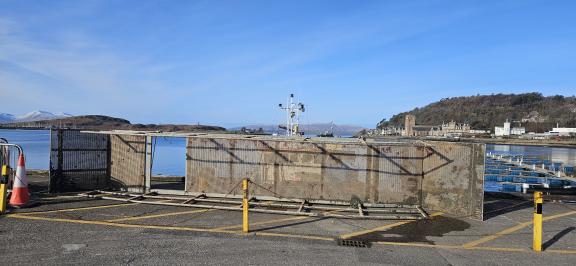
Recovered Bridge - the lost bridge on the pier ready for inspection
Mooring Chains Lifted
Tuesday and Wednesday saw the team focused on the heavy mooring chains that connect each breakwater unit. Using the lifting gear aboard the CT Barnston, the crew worked carefully to raise each chain and detach it whilst trying to avoid further damage to the units. Each chain weights around two tonnes and needed to be carefully lifted, detached from the unit, attached to a mooring buoy and gently replaced into the water. They also needed to carefully sequence the work around the units to ensure the chains didn't become entangled or caused any undue twisting to the units.
Their careful approach paid off and by the middle of the week, they had successfully freed the units and were able to remove Breakwaters 2 and 3, relocating them safely inside the shelter provided by Breakwater 1. This creates a more controlled environment for the next stages of the repair programme.
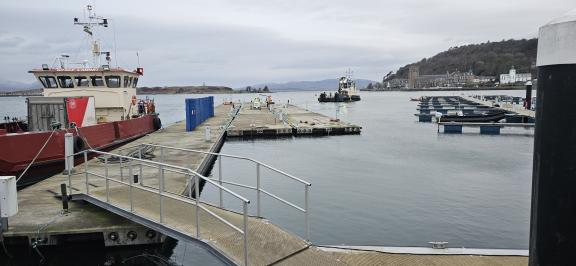
Breakwaters 2 and 3 alongside - both breakwaters safely relocated and ready to be separated
This stage of the project had originally been expected to take three days per unit, but thanks to the team’s hard work and efficient planning, both units were completed in just two days. This strong progress is a key reason why the decision was made to carry out this work now, rather than before the Christmas break when weather and daylight would have made operations much more difficult.
Mooring Chains Tidy
The team of divers spent Thursday cleaning and inspecting the mooring chains and ensuring they were tidy in preparation for when the breakwaters are re-attached. Some defects have been found that were general wear and tear and not specifically caused by the storm. These defects in the links will be replaced as part of this work.
We will continue to provide updates as the work progresses.
Update – 13 February 2026
Shearwater Marine Services Ltd commenced work on site on Monday to begin carrying out the temporary repairs.
This work will include relocating the damaged sections in the facility to maximise the usable berthing area, building on the limited opening in 2025. In parallel, design work for permanent replacement units is underway.
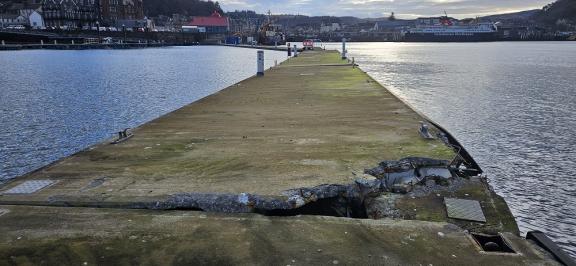
Looking towards the North Pier, showing the most damaged unit, with Oban in the background.
Working from their support vessel, the Grace Lamont, Shearwater’s dive team has started by inspecting the underwater condition of the breakwater units and their mooring chains before beginning the careful process of detaching and repositioning them. Further updates will be provided as the work continues over the coming weeks.
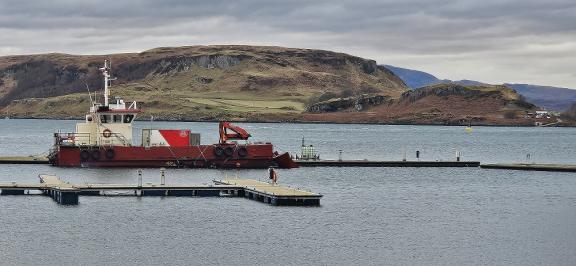
The Grace Lamont alongside the damaged breakwater - with the Island of Kerrera in the background.
What is being done
A key priority of Argyll and Bute Council is to re-open as much of the facility as possible from April of 2026 and to ensure Oban can welcome the returning Clipper Race participants in July 2026.
The recommended approach to meet these deadlines involves relocating damaged units from the middle of Breakwater 2 to the outermost section of Breakwater 3. This configuration is expected to increase available berthing by allowing the second section to reopen, and increase the berthing capacity by 160 metres. Permanent replacement units would then be designed over the summer and installed over the following winter period of 2026/27.
The working being carried out this Spring will involve uncoupling breakwater units, repositioning them and re-tensioning the system. It is not yet known if the third section of breakwater will be re-opened, this will depend on whether successful re-tensioning can be achieved given the damage and confirmation will be provided as the works continue.
Safety remains the Council's priority, and we thank users and the community for their continued patience while these works are carried out. Further updates will be shared as the works progress.
What happened
The North Pier pontoons are an important part of Oban’s waterfront, offering valuable access for local users, visiting vessels, and the wider marine community. Over the past year, they have been affected by significant weather‑related damage. On 24 January 2025, Storm Eowyn caused significant damage to the facility, including visible damage to the pontoons and breakwater sections that protect the inner berthing area. As a safety precaution, the facility was initially closed completely to allow comprehensive above and underwater inspections.
A detailed dive survey examined the mooring chains, anchor blocks and underside of the units to assess the overall integrity of the pontoon system. Initial repair work was undertaken to some fixing points, and several damaged pontoons floats were replaced allowing the inner finger pontoons to reopen safely in March 2025.
Additionally, divers confirmed the first section of breakwater, which provides approximately 200m of berthing area, was sound and could be re-opened for use by larger vessels.
However, due to the damage encountered, the remainder needed to stay closed for safety reasons.
To plan the necessary long‑term repairs, specialist consultant engineers reviewed the dive report findings along with earlier investigations into cracking that had been seen on some units prior to the storm. They developed a range of repair and replacement options, each with corresponding timescales.